Have you ever looked at a stunning aerial shot and wondered, “How do they capture that? What goes on behind the camera—or in this case, behind the drone?” Well, you’re not alone. Many people are fascinated by the beauty of aerial photography, but few know what goes into the process of capturing that perfect shot from the sky. In this post, we’re going to take you behind the scenes of one of our recent drone shoots, share the technical details, and tell you a story about how we turned an idea into breathtaking footage.
Grab your popcorn (or maybe a cup of coffee), and let’s dive into the world of drone photography!
Setting the Scene: The Vision
Every drone shoot starts with a vision. Whether it’s a real estate listing, an event, or a business needing promotional material, the vision guides every aspect of the shoot. In this particular shoot, we were contacted by the owners of a beautiful estate tucked away in the countryside. The goal was to capture the property in a way that would not only showcase its grandeur but also the peaceful, natural surroundings.
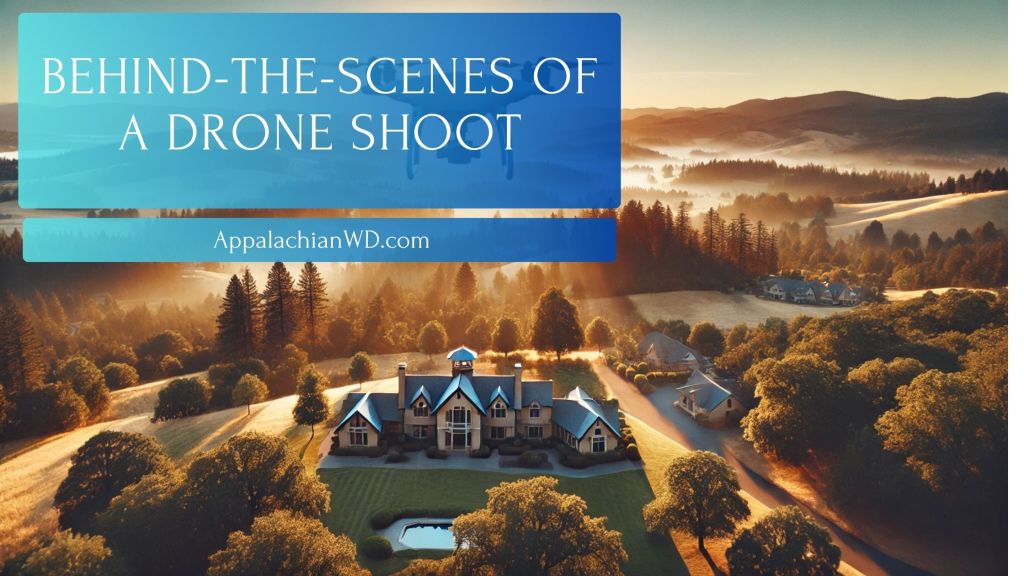
Imagine towering oak trees lining a long driveway that leads to a sprawling house with a backyard that stretches out into the horizon. There’s a pond reflecting the clear sky, and beyond that, rolling hills. Our job? To capture this serene setting and turn it into a promotional video for the homeowners, who wanted to highlight the property for potential buyers.
But how do you bring that vision to life with a drone?
Step 1: Scouting the Location
Before we even launch the drone, we always start with location scouting. This is crucial because not every spot is drone-friendly, and understanding the layout of the land helps us plan the shots.
We visited the estate a couple of days before the shoot to get a sense of the property. It’s not just about flying the drone randomly and hoping for the best shot; it’s about knowing exactly what angles and perspectives will best showcase the beauty of the location. We walked the entire property, imagining where the drone could take off and what paths it could follow to highlight key features like the pond, the garden, and the wide open space.
As we scouted, we also had to consider obstacles like trees, buildings, and power lines. These are important not only for safety but also to avoid any distractions in the footage. The last thing you want in a sweeping aerial shot of an estate is an accidental crash into a tree branch!
Step 2: Preparing the Equipment
Drone shoots are much like any other photography or videography project in that the right equipment is essential. For this shoot, we chose the DJI Phantom 4 Pro. It’s a powerful drone with a great camera, capable of shooting in 4K resolution. Plus, it has fantastic stabilization, which means we can get smooth, cinematic footage even when there’s a bit of wind.
However, it’s not just about the drone. Here’s a quick rundown of the other gear we prepped for the shoot:
• Extra batteries: Drone batteries don’t last forever, especially when filming for long periods. Each battery typically gives us about 25-30 minutes of flight time, so we always bring extras.
• ND filters: These filters help control exposure, especially on bright days. They’re like sunglasses for the drone camera, ensuring we don’t get overexposed footage.
• Remote control with live video feed: This allows us to monitor exactly what the drone is capturing in real-time.
• Safety gear: It might sound trivial, but always having first-aid kits, cones to mark off the drone takeoff area, and even backup drones in case of technical issues is crucial.
Step 3: Timing Is Everything
Timing is one of the most important aspects of drone photography. You don’t just show up at any time of the day and start filming—lighting can make or break the quality of your footage.
For this shoot, we planned to capture the estate during golden hour—that magical time shortly after sunrise or just before sunset when the lighting is soft, warm, and perfect for capturing the natural beauty of the landscape. Golden hour adds depth to the footage, enhances colors, and gives everything a beautiful glow.
The problem? Timing has to be precise. The golden hour doesn’t last long—about an hour, give or take—so we had to make sure everything was ready to go. There’s no room for mistakes when you’re racing against the setting sun.
Step 4: The Drone Takes Flight
With everything prepped and the sun beginning its descent, it was time for the drone to take off. As we launched the drone into the air, it felt almost like a bird soaring above the trees, capturing the estate from angles impossible to see from the ground. Watching it fly into position, I couldn’t help but think about how different drone photography is from traditional ground-based shooting.
In this particular shoot, our plan was to start with a wide sweeping shot of the estate, moving from the driveway and gradually panning out to reveal the entire property, the pond, and the hills beyond. To capture this, we flew the drone over the house, keeping it low at first, then slowly increasing the altitude to get a bird’s-eye view.
As the drone hovered higher, the full extent of the landscape became visible. From the camera feed, we could see how the pond reflected the glowing sky, the house framed by trees, and the open fields stretching into the distance. It was everything we envisioned.
Step 5: Capturing Different Angles
To make the footage engaging, we knew we needed more than just one wide shot. So we began experimenting with different angles and movements. For example:
• Slow, sweeping motions: We flew the drone low over the pond, capturing the reflection of the setting sun. Slow, steady movements create a cinematic feel.
• Flyovers: We had the drone fly over the house and then turn around to reveal the driveway and surrounding trees. This reverse flyover trick gives a dynamic perspective shift.
• Vertical shots: One of the most impressive shots we captured was from directly above the estate, showing the symmetrical layout of the house, pond, and surrounding gardens.
We also made sure to capture multiple shots of each angle—sometimes with different exposures—so that we would have plenty of options to work with during post-production.
Step 6: Challenges During the Shoot
No shoot is without its challenges, and this one was no different. Despite all our preparation, there were a few unexpected issues.
For one, wind started picking up halfway through the shoot. Even though our drone had great stabilization, strong winds can make it difficult to capture smooth footage, especially when doing precision shots like close flyovers. We had to adjust our flight paths and wait for calmer conditions to finish some of the shots.
Another issue was battery life. We had multiple batteries, but switching them out mid-shoot can disrupt the flow, especially when trying to capture the fading light of golden hour. We made sure to rotate the batteries quickly, keeping the drone in the air as much as possible.
Step 7: Post-Production Magic
After the shoot, the real magic happens in post-production. This is where we edit the footage, enhance colors, and piece together the final video.
For this shoot, the footage was already stunning, thanks to the lighting and location, but post-production allowed us to take it to the next level. We used editing software like Adobe Premiere Pro to color-grade the footage, giving it a slightly warmer tone to match the peaceful, serene vibe of the estate. We also added slow-motion effects to certain clips, making the movements feel smoother and more cinematic.
The final result? A breathtaking aerial tour of the estate that highlighted its beauty in ways that would’ve been impossible with ground-level photography alone.
Conclusion: The Perfect Shot, Achieved
Capturing the perfect aerial shot is much more than just sending a drone into the sky and hoping for the best. It requires careful planning, attention to detail, and the ability to adapt to changing conditions. From scouting the location to timing the perfect shot at golden hour, every step of the process plays a critical role in creating stunning drone footage.
At the end of the day, the key to a successful drone shoot is not just the technology—it’s the vision behind it and the creativity to make that vision come to life. And while it can be challenging at times, the payoff is worth it when you see the final, breathtaking shots.
So the next time you look at a beautiful aerial shot, remember that there’s much more going on behind the scenes than meets the eye! Whether it’s showcasing a property, a business, or capturing special moments, drone photography brings a whole new perspective to the table, and we’re here to make that vision soar.
 Blue Ridge Nexus
Leave a comment